

What if unrolling your mat was more than just a simple workout?
What if, between two poses, there was a real tool to soothe anxiety, lighten thoughts, and find a little inner calm?
Spoiler: that's exactly what yoga offers 🌿
Today, we talk a lot about mental health (and that's a great thing). Stress, mental load, anxiety, emotional fatigue... our minds are often as strained as our bodies.
The good news? Yoga is one of the most complete practices for gently taking care of your mind.
We'll explain why... and especially how to integrate it into your daily life.
 🌿 1. Why yoga directly affects the mind
Yoga doesn't just work the body. It acts on a key system: the nervous system.
Specifically, our body operates in two main modes:
– "alert" mode (stress, action, agitation)
– "rest" mode (calm, recovery, digestion)
Problem: today, many of us remain stuck in alert mode.
Emails, children, mental load, notifications... the brain never truly stops.
👉 Yoga helps rebalance all of this.
Thanks to breathing, slow movements, and concentration, it activates the parasympathetic nervous system, responsible for calm and relaxation.
Result:
✨ heart rate slows down
✨ breathing becomes deeper
✨ the mind calms down
And that's not just a feeling: it's physiological.
 😌 2. Yoga and anxiety: a game-changing duo
If you've ever felt:
– your mind racing
– a knot in your stomach
– a feeling of being "on edge"
... then you've already experienced anxiety.
Yoga works on several levels to reduce it.
🫁 Breathing: your "reset" button
In yoga, you learn to breathe. Really.
Slow, deep breathing sends a direct message to the brain:
👉 "you can relax"
Certain techniques like:
– abdominal breathing
– heart coherence
– long exhalations
can reduce anxiety in just a few minutes.
Yes, a few minutes.
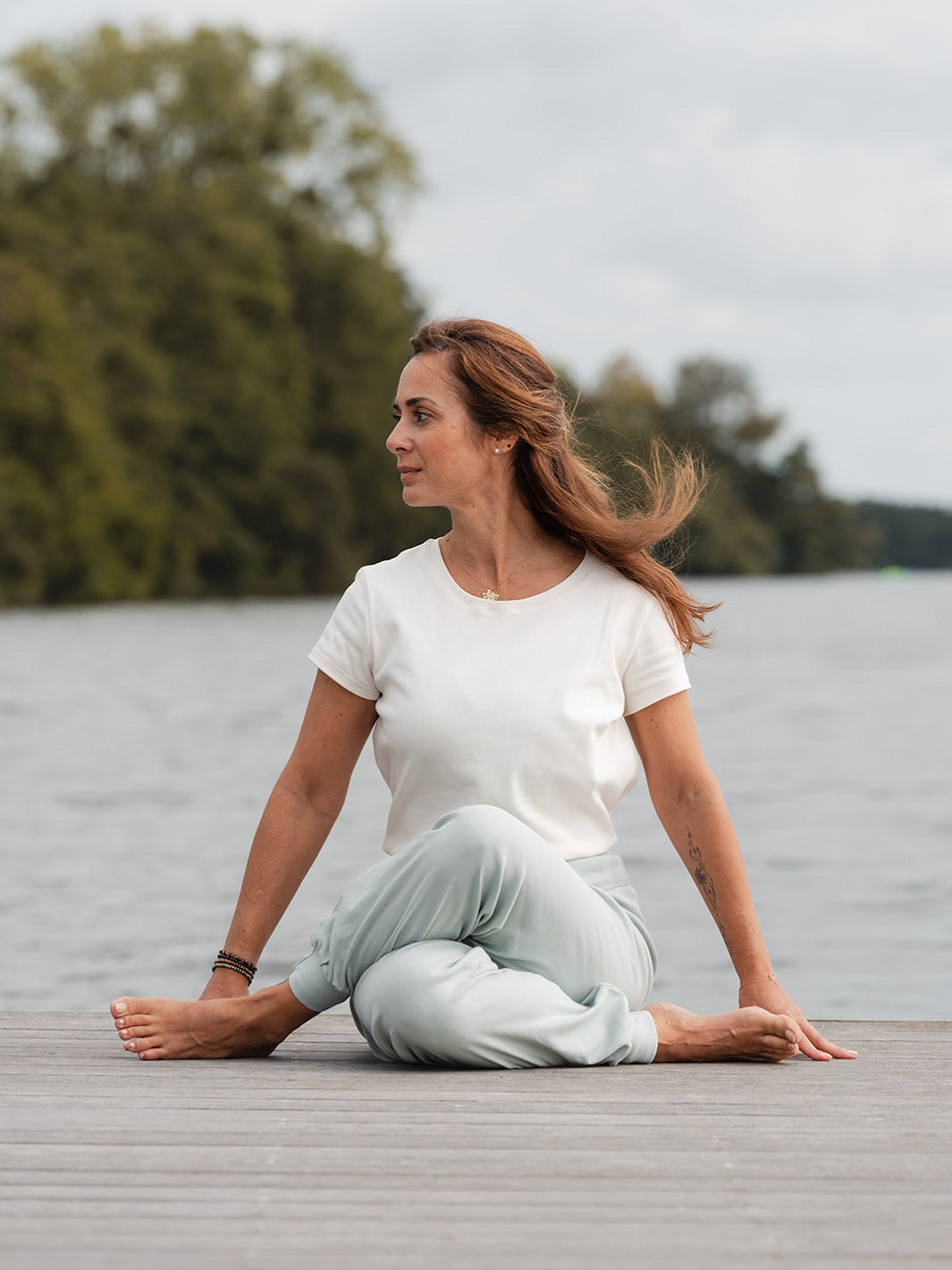
🧘♀️ Movement: getting out of your head and back into your body
When you're anxious, you're often... in your head.
Yoga helps to:
– return to sensations
– feel your body
– slow the flow of thoughts
A pose held for a few breaths becomes an anchor in the present.
And little by little, the mind calms down.
🌿 Attention: training your mind
Yoga is a form of meditation in motion.
You focus on:
– breathing
– alignment
– sensations
👉 Result: you train your brain not to follow every thought
And that's a valuable skill against anxiety.
 🌧️ 3. Yoga and depression: gentle support
Please note: yoga does not replace medical supervision.
But it can be an extremely valuable complement during more difficult times.
☀️ Putting the body back in motion
Depression is often accompanied by:
– fatigue
– lack of energy
– loss of motivation
Yoga, even gentle yoga, gets the body moving again.
And movement is life.
It particularly stimulates the production of neurotransmitters like:
– serotonin (mood)
– dopamine (motivation)
💛 Reconnecting with yourself
When you're not well, you often feel disconnected from yourself.
Yoga creates a space to:
– reconnect with your sensations
– listen to yourself without judgment
– find yourself again
Even 10 minutes are enough to recreate this connection.
🌿 Cultivating gentleness
Yoga teaches something fundamental:
👉 you don't have to be perfect to practice
And that is profoundly restorative.
You progress at your own pace, without pressure, without comparison.
 ⚖️ 4. The concrete benefits of yoga for mental health
With regular practice, we often observe:
✨ a reduction in stress
✨ better sleep
✨ less rumination
✨ better emotion management
✨ a more stable sense of calm
And above all…
👉 an ability to gain perspective
 🧘♀️ 5. Which yoga to choose for your mind?
Good news: there isn't just one type of yoga.
And some styles are particularly suited for mental health.
🌙 Yin yoga
Long, floor-based poses, very slow
👉 perfect for deep release
🌿 Hatha yoga
Moderate pace, balance between effort and relaxation
👉 ideal for beginners
💫 Gentle Vinyasa
Fluid sequences
👉 helps to "unburden" the mind
🪶 Restorative yoga
Very gentle, with props
👉 for deep rest
👉 The important thing: choose a practice that makes you feel good
(and not one that makes you feel like you "have to perform")
 🕊️ 6. How to integrate yoga into your daily life?
No need to practice for 1 hour every day.
👉 Regularity matters more than duration
💡 A few simple ideas:
– 5 minutes of breathing in the morning
– 10 minutes of stretching in the evening
– 1 session per week
Even a mini ritual can make a real difference.
 💛 7. The true superpower of yoga
Beyond the postures, yoga teaches us:
– to slow down
– to listen
– to breathe
– to be present
In a fast-paced world, this is almost revolutionary.
 ✨ Conclusion: a mat, a breath... and a lot of gentleness
Taking care of your mental health doesn't always require big changes.
Sometimes, it's enough to:
– unroll your mat
– breathe
– move gently
And let the body do the rest.
Yoga is not a miracle solution.
But it is a simple, accessible, and profoundly transformative tool.
What if now was the time to make space for it in your daily life? 🌿


Leave a comment